Under our logo stand three words: menschen, hardware, knowhow. Two of them — people and know-how — are not about devices at all, but about persons: about what they can do, learn and become. That is no accident. A used laptop that others wrote off long ago works again after being repaired — and reaches, via our marketplace, someone who needs it. That is the visible half of our mission. The other half is about people who have fallen out of working life or never properly found their way into it, and who find with us a place where their contribution counts.
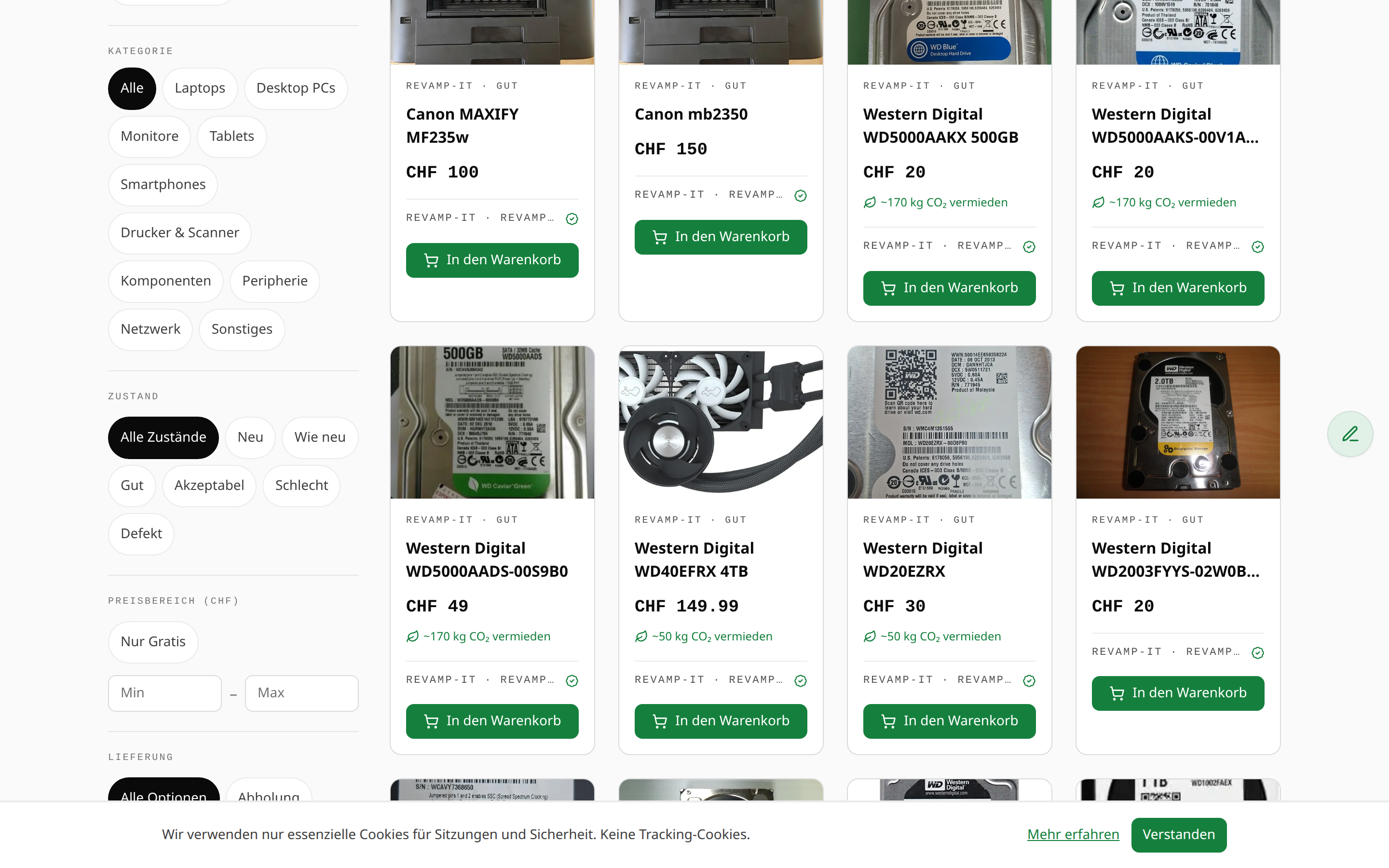 The visible half: tested, refurbished devices on the marketplace — each with transparent CO₂ savings. A person prepared, photographed and described every one of these listings.
This is not a by-product. Anyone who tests, repairs, catalogues and passes on devices at Revamp-IT does real work with real value. That is precisely why this place is so well suited to getting back into work: there is no occupational therapy here, but a workshop, a marketplace, workshops and IT help — an organisation that depends on the work being done. Our reintegration programme is built exactly on that: structured work experience, individual support, a pace that fits the person.
Why getting back into work is hard — and what the research says about it
The labour market filters harshly. A gap in the CV, a long illness, an exhaustion, a break in one's biography — and suddenly you can't get past the first hurdle. The problem is rarely a lack of ability. It is the missing proof that you contribute reliably, and often enough the lost belief that you can still do it at all.
That unemployment is not only a financial but a psychological problem is well documented. The large meta-analysis by Karsten Paul and Klaus Moser evaluated 237 cross-sectional and 87 longitudinal studies and found a clear connection: among the unemployed, on average 34 % showed psychological complaints, among the employed only 16 %. What is decisive is that the longitudinal data clarify the direction — it is not merely that psychologically burdened people more often lose their jobs; losing work itself worsens mental health, and returning to work improves it again (Paul & Moser, Unemployment impairs mental health: Meta-analyses, Journal of Vocational Behavior, 2009). Reintegration is thus not only economically sensible, it is, in the literal sense, healing.
Why that is so was described by the social psychologist Marie Jahoda back in 1982. Besides the wage, work pays out five "latent" benefits that we hardly notice as long as we have them: a time structure for the day, social contacts outside the family, a shared goal beyond one's own person, status and identity, and simply regular activity. When work falls away, all five fall away too — and those are precisely what the people who come to us often lack more than the money.
That this is not just an old theory is confirmed by newer data from the German-speaking world. An analysis of the German panel "Labour Market and Social Security" with over 9,300 respondents found that the unemployed score worse on all five latent functions than the employed — and indeed even compared with people in small part-time jobs, where the wage barely matters (Bähr & Collischon, Erwerbsarbeit erfüllt wichtige psychologische Funktionen, IAB-Forum, 2022). So it really is the work itself, not just the income, that is missing.
What people in this situation need follows directly from that: a structure that carries without overwhelming. Tasks that you actually complete and whose results you see. A team that treats you as a colleague and not as a case. And — quietly but decisively — evidence. Something that shows: I did that. I can do that. I learned that.
It is exactly at this point that a workshop question becomes a portal question. Because a large part of what carries reintegration is the visibility of contribution and development — and visibility is something software does well.
What the portal can already do today
The portal's collaboration page was not designed as a social tool. But precisely because it maps normal, honest team work, it works for reintegration. Four building blocks are productive today:
Personal profiles. Every person working with us has a profile with skills, interests, goals, strengths and areas of development — not as a rigid personnel file, but as a growing description of what someone can do and where he or she wants to go. A profile already bundles everything a person has contributed: their listings on the marketplace, the services and IT help they offer, workshops they give, and articles they have written.
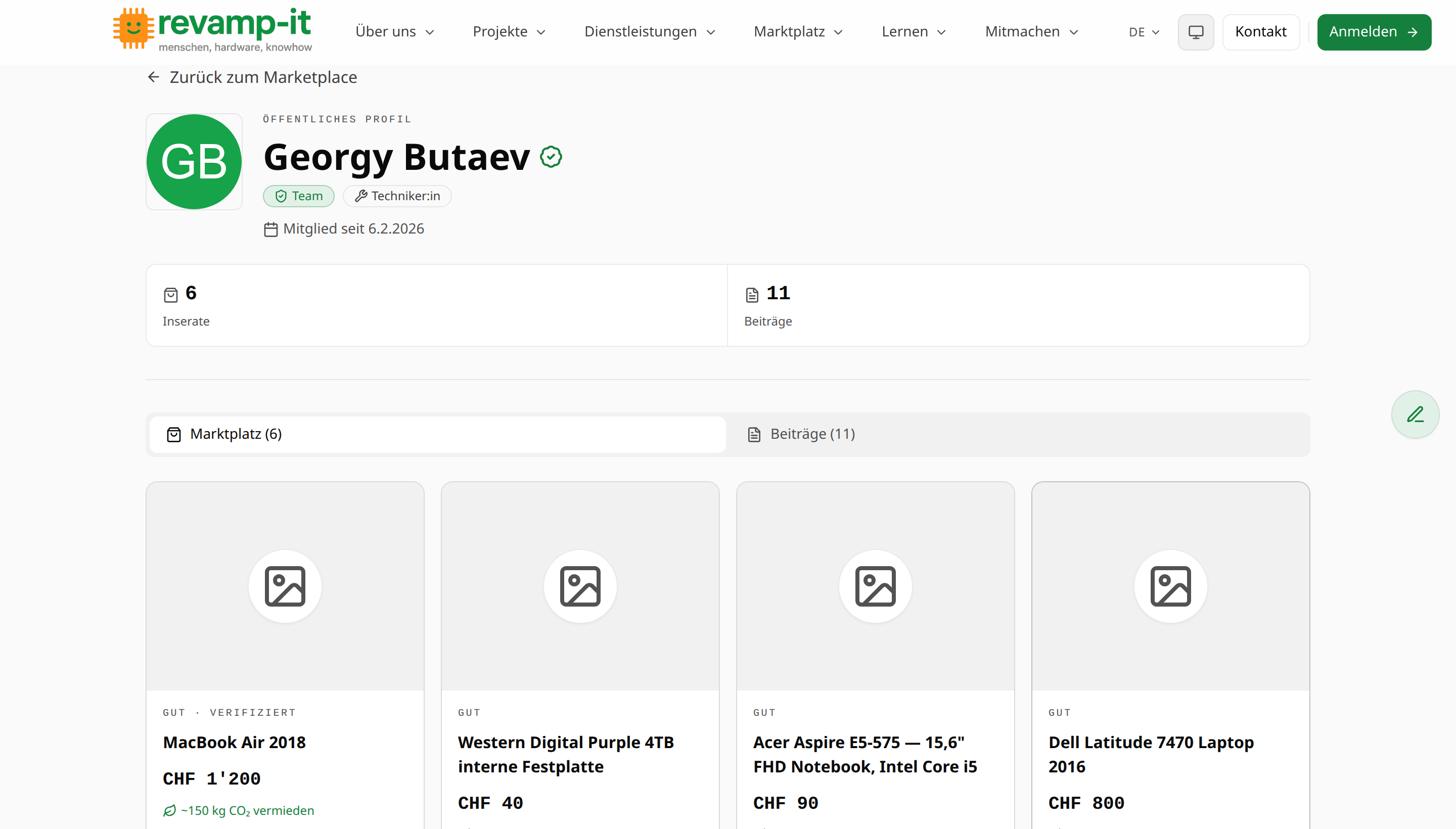 A public profile bundles everything a person has contributed — here six listings and eleven articles, each with visible impact. From individual actions grows a provable trail.
Skills are keywords that accumulate over time. Goals, strengths and areas of development stand in their own "Development" view that each person maintains for themselves. Added to this is a "current focus": a sentence about what one is currently working on, which becomes visible to the team on the "who's doing what" board. Someone just starting out perhaps has three entries; after half a year there are twelve. This curve is often the first tangible sign for the person that things are moving forward.
Team profiles. In the portal, teams are independent units with their own goals and metrics. A team has a list of goals with status and a handful of metrics by which it measures its progress. For someone who stood outside for a long time, belonging to such a visible unit is more than organisation — it is an "I belong here." You are not at Revamp-IT, you are in the workshop team, and the team has a goal you contribute to. That is precisely the third of Jahoda's latent benefits — the shared goal beyond one's own person — cast in software.
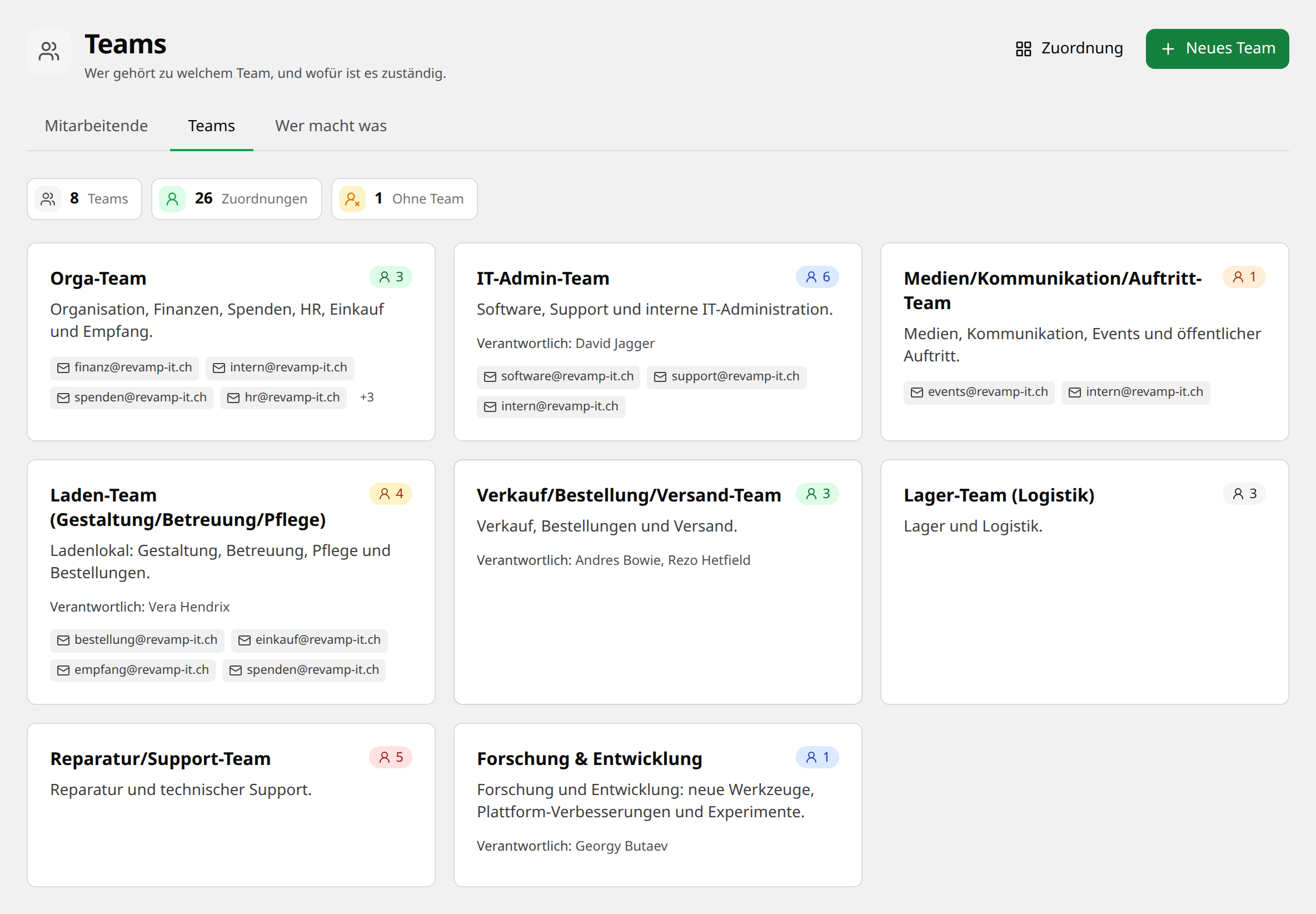 The teams in the portal — from the repair team to the shop team to the warehouse team, each with a clear responsibility and a handful of members. Anyone joining sees at a glance where they belong and what their team stands for. On the left the "Collaboration" group, where tasks, deliverables and minutes come together.
Tasks. Tasks can be assigned, given a due date and priority, allocated to a team and ticked off; an assistant helps turn two sentences into a clean task. That sounds trivial and isn't: a completed, assigned task is a small, finished proof of reliability. Many small proofs add up over time into a pattern you can rely on — the person themselves first of all.
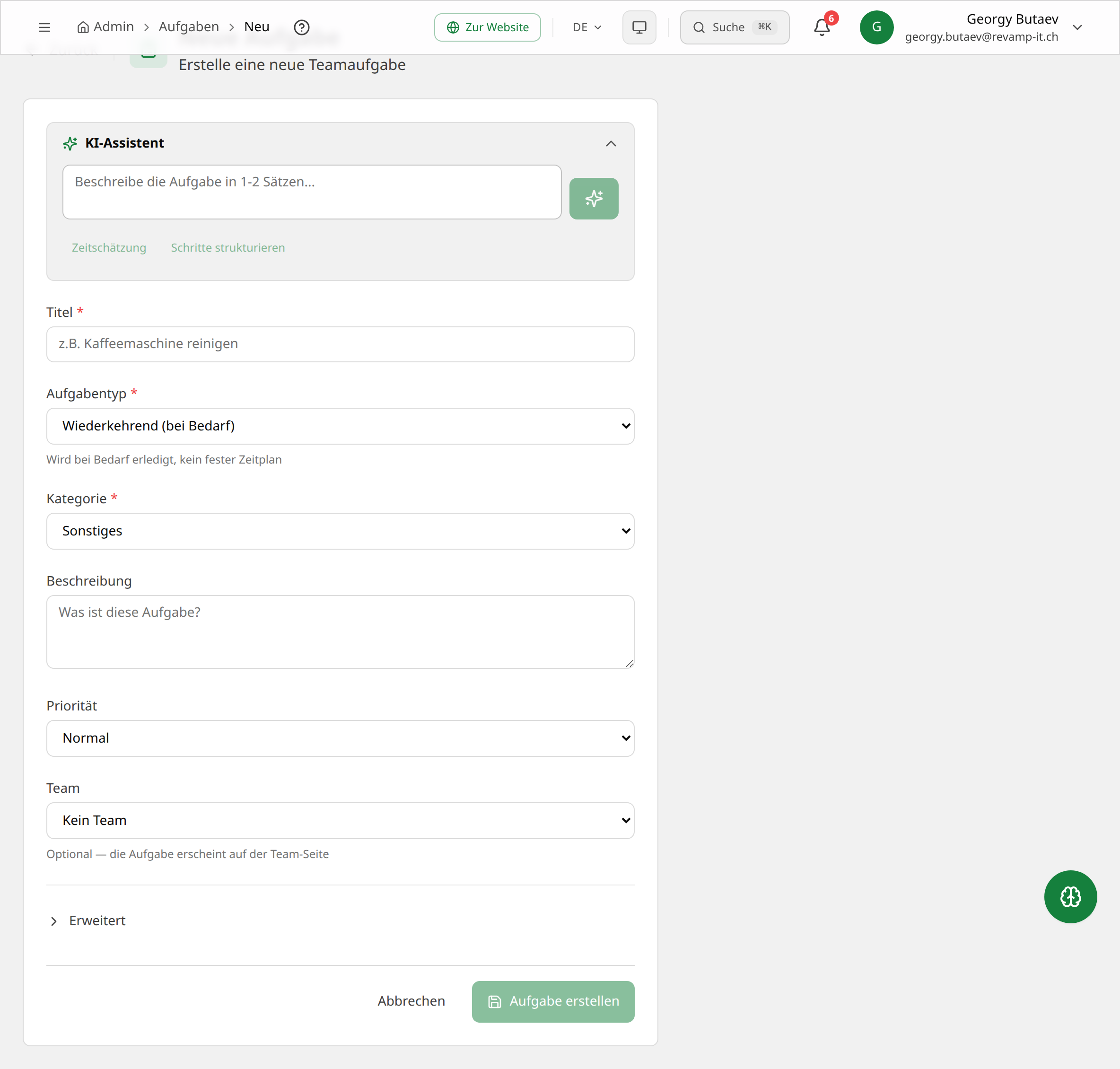 A new task: type, category, priority and team are quickly set — and an assistant turns a short description into a clear, tickable task. Small steps, clearly outlined, are easier to accomplish — and every one accomplished counts.
Decisions and votes. In the decisions area, proposals are discussed and then voted on — with a clear flow from draft through discussion to the vote, and with different methods depending on the question, from a simple yes/no to consent, where it is not about the majority but about workable agreement. Every vote counts equally. For someone who long felt unasked, a voice that weighs as much as any other is a strong signal: Your view is part of the decision.
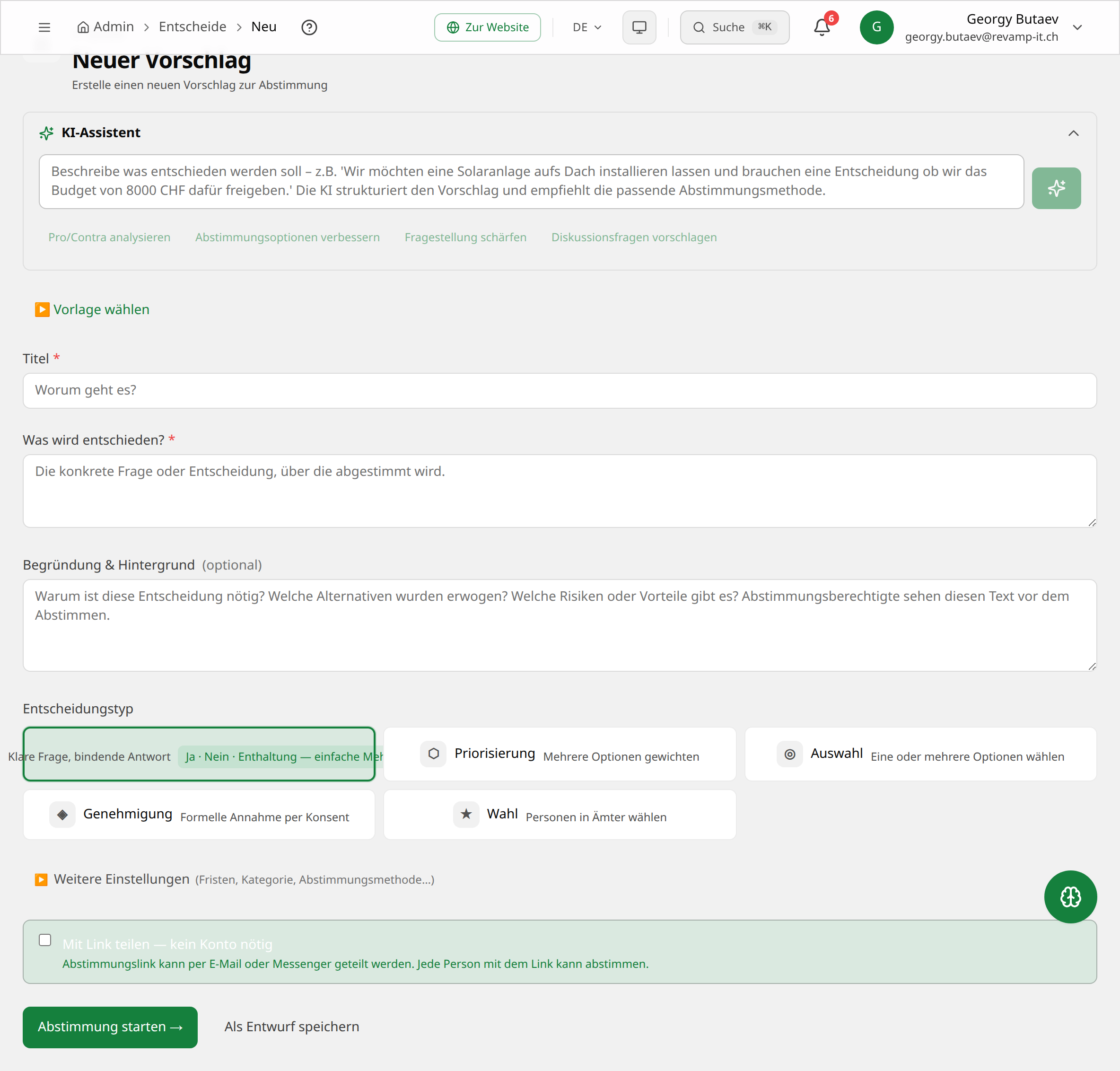 The proposal editor: every decision gets a type that fits the question — from "Clear question, binding answer" through prioritisation and selection to "Approval by consent." The flow from draft through discussion to the vote is equally visible to everyone — participation here is not a promise but a feature.
Added to this are deliverables and minutes — reports, presentations and notes that record what a team produces and discusses. And on the HR side, the portal also formally maps reintegration: there is a dedicated track for returners with onboarding building blocks such as a reintegration interview and an assigned contact person for the first weeks.
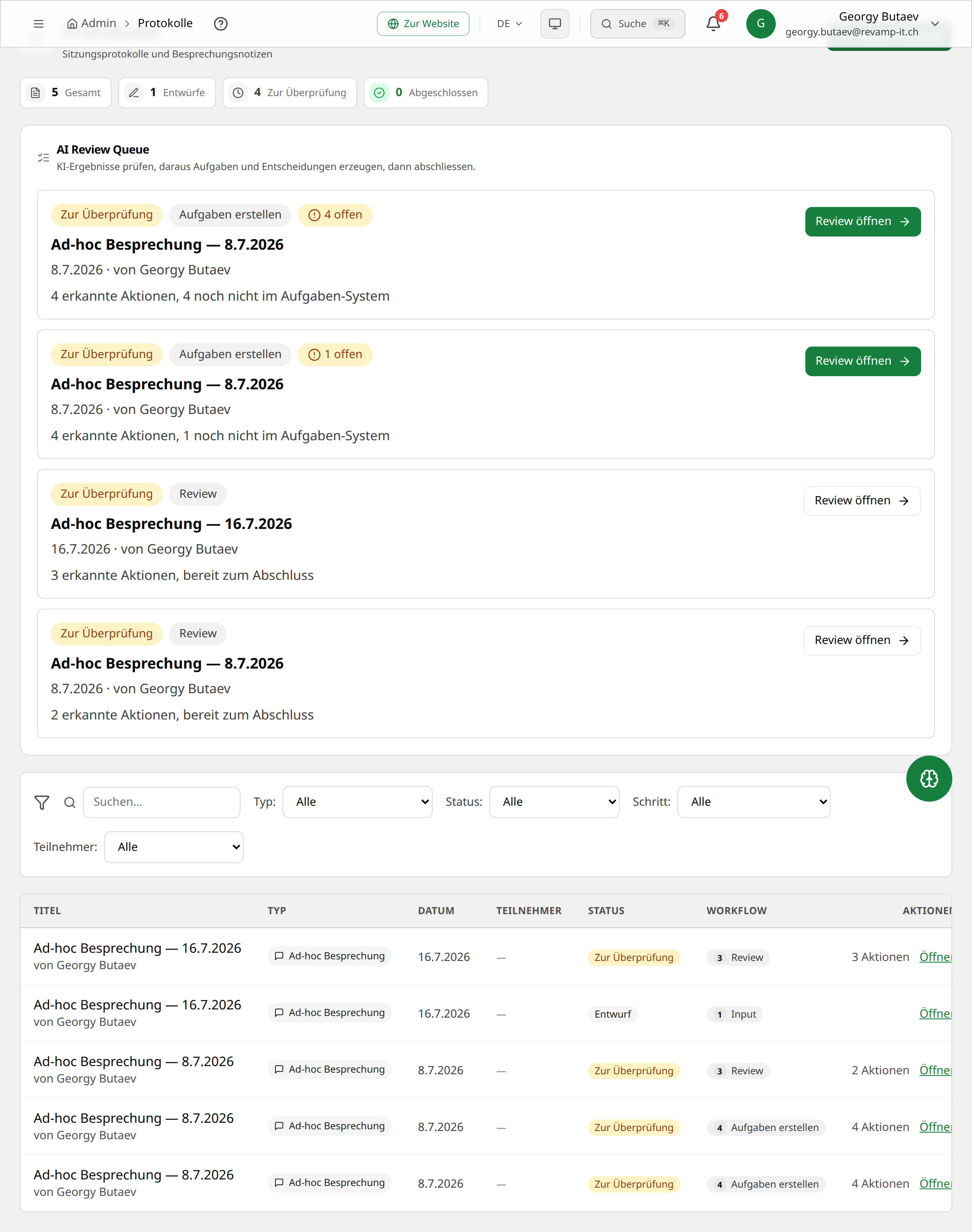 Minutes record what was discussed — and a review view turns it into concrete tasks and decisions, instead of letting it fade away into notes. So "we talked about it once" becomes a traceable thread everyone can keep working on.
Why collaboration on equal footing works — and where its limits lie
These building blocks are not chosen arbitrarily. They follow, consciously or not, what research on work and motivation knows about successful collaboration. A helpful framework is the self-determination theory of Edward Deci and Richard Ryan: people motivate themselves — and stay healthy while doing so — when three basic needs are met: autonomy (being able to help decide), competence (seeing that one can do something and is learning) and relatedness (being part of a "we") (Ryan & Deci, Self-Determination Theory and the Facilitation of Intrinsic Motivation, American Psychologist, 2000). It is exactly these three that the collaboration page serves — and for the work context the connection is well documented: an autonomy-supportive work climate produces the kind of motivation that goes hand in hand with better performance, more learning and higher well-being (Gagné & Deci, Self-Determination Theory and Work Motivation, Journal of Organizational Behavior, 2005).
Autonomy — helping decide. That every person's voice counts equally is more than a nice gesture. The Zurich economist Bruno Frey showed, together with Alois Stutzer, that people derive an independent value from taking part in decisions — the "procedural utility" — regardless of how the decision turns out (Stutzer & Frey, Institutions Matter for Procedural Utility; the exact strength of the effect is contested in the research, the value of taking part itself is not). The codetermination research of the German Hans-Böckler-Stiftung likewise links genuine participation with more resilient enterprises (Why Codetermination?, IMU / Hans-Böckler-Stiftung). The various voting methods in the portal — from the simple majority to consent — stem from this tradition: consent, in which a decision stands as soon as no one has a reasoned objection anymore, is the core of the sociocracy developed by Gerard Endenburg.
Relatedness — a "we." That teams in the portal are their own units with names, goals and metrics is not an org-chart detail. The social psychology of groups shows that performance and cohesion rest on a shared social identity — a real feeling of "we" that turns many individual contributions into joint effort (Haslam & Reicher, Rethinking the Psychology of Leadership, Daedalus, 2016). For someone who stood outside for a long time, this "I belong to the repair team" is often the first thread back.
Competence — visible progress. That the profile records things achieved and that tasks are clear and tickable hits a third well-documented point: concrete, appropriately demanding goals with feedback lead to more performance and learning than a vague "do your best" (Locke & Latham, Building a Practically Useful Theory of Goal Setting, American Psychologist, 2002). A completed task is exactly such a small, feedback-backed goal achievement.
And where the limits lie. As much as the research supports these building blocks — it just as clearly supports their limits, and to be honest means naming them too:
- Software does not create psychological safety. Amy Edmondson showed that teams only learn openly when it feels safe to say something or admit a mistake (Edmondson, Psychological Safety and Learning Behavior in Work Teams, Administrative Science Quarterly, 1999). A voting tool invites participation; whether someone dares to use it is decided by the human climate, not the feature. Precisely with people returning to work this is the real lever — and it lies with the colleagues, not in the code.
- Equal votes are not automatically equally strong votes. Someone who long felt unasked does not feel entitled to vote along on the first day. The formal equality of the vote is the precondition, not yet the result.
- Transparency can tip into surveillance. Bruno Frey and Margit Osterloh described how external control pressure can crowd out inner motivation — "motivation crowding" (Osterloh & Frey, Motivation Governance). Antoinette Weibel and colleagues show that precisely in meaning-driven organisations controlling incentives carry "hidden costs" (Weibel, Rost & Osterloh, Pay for Performance in the Public Sector — Benefits and (Hidden) Costs, 2010). A "who's doing what" board is a gift as long as it provides orientation — and a risk the moment it turns into control. That is why the same line applies here as with impact measurement: for the person, not about the person.
- Goals can turn against their purpose. The same research that praises goals also warns: a hard-set goal on the wrong metric tempts you to optimise the number instead of the thing. Team metrics must therefore be chosen with care.
These limits are not a contradiction to the usefulness of the tools, but its condition: they work precisely when they support good human collaboration instead of trying to replace it.
The profile as a tool for self-confidence
The most important of these building blocks is the personal profile — not because of the technology, but because of the effect. And here a look into the research is once again worthwhile.
The psychologist Albert Bandura showed that self-efficacy — the belief that one can actually master a thing — has its strongest source in one's own experiences of success. Not encouragement, not observing, not positive thinking, but having accomplished something oneself changes the conviction most lastingly (Bandura, Self-efficacy: Toward a unifying theory of behavioral change, Psychological Review, 1977). That is exactly what a well-kept profile provides: it is a record of one's own experiences of success. Every catalogued device, every listing, every completed task is a small, documented proof — and proofs you see in black and white work more strongly than any "you can do it."
A profile that places skills, interests and goals side by side does three things at once. It makes ability visible: what before was only a diffuse "I'm somehow OK with computers" becomes a concrete list — hardware diagnostics, data erasure, customer conversation, cataloguing. It makes development visible: the list grows, and growth you see, you are more likely to believe. And it records direction: interests and goals remind you that a person with wishes works here, not a function.
For the labour market that is precisely the raw material that is otherwise missing. A well-kept profile is the beginning of a portfolio: an honest, provable answer to the question "What can you do?" Anyone who learns with us to test devices and prepare them for the marketplace also learns, along the way, things that count everywhere — technical troubleshooting, careful work by checklist, customer contact, team coordination, a feel for deadlines. The portal is the place where these skills are not lost but accumulate.
Real work that carries: from repair to hand-over
The experiences of success that a profile records do not arise in a vacuum. They arise from real jobs. In IT help, for instance, people with a repair need meet technicians who can help — a two-sided network in which supply and demand find each other.
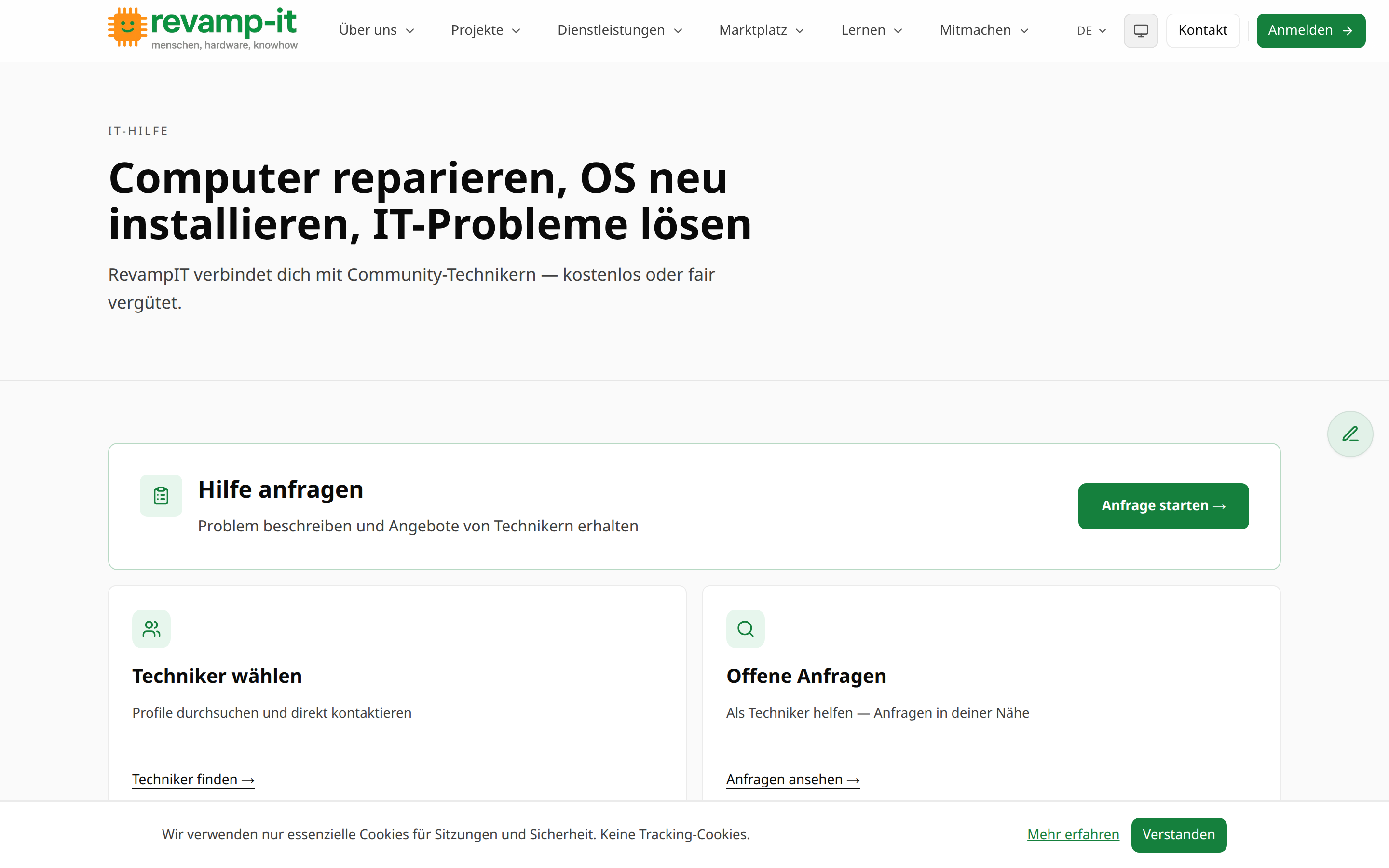 IT help connects repair needs with technicians. Anyone taking part in reintegration collects real jobs here — and real feedback from real people.
The difference from a sheltered practice situation is decisive. A customer whose laptop runs again does not thank you for an exercise, but for a worry solved. A buyer who buys a tested device on the marketplace relies on the test being correct. This seriousness is what carries self-confidence: you are needed, not kept busy.
A programme that takes "place first, then train" seriously
How to best support people back into work is astonishingly well researched. The most effective approach for people with restricted access to the labour market is called Individual Placement and Support (IPS) — in German most closely "supported employment." Its basic principle reverses the old order: not first practising for a long time in sheltered workshops and then at some point switching to real work ("train then place"), but standing in real work as early as possible and applying the support there ("place then train").
The evidence for this is clear. An international meta-analysis of 17 randomised controlled trials found that people with IPS support found regular employment around 2.4 times more often than people in classic vocational rehabilitation (Modini et al., Supported employment for people with severe mental illness, British Journal of Psychiatry, 2016; overview at the IPS Employment Center). The same analysis is honest in its limitation: in economically weak times the advantage shrinks, because IPS too depends on real, available jobs. All the more valuable is an organisation that itself continually has real work to assign.
For Switzerland this effect is directly documented — and indeed here in Zurich. In a randomised study by the Psychiatric University Hospital Zurich with 250 disability pensioners with a mental illness, within two years 32 % of the IPS-supported group found a job on the primary labour market — compared with only 12 % in the classically supervised control group (Viering et al., Supported Employment for the Reintegration of Disability Pensioners with Mental Illnesses, Frontiers in Public Health, 2015). A six-year follow-up by the same research group is remarkably honest about it: the initially clear lead (40 % versus 28 % after two years) evens out over the years (36 % versus 33 % after six years) (Pichler et al., Long-Term Effects of the Individual Placement and Support Intervention, Frontiers in Psychiatry, 2021). The finding is a pointer we take seriously: a good start alone is not enough — the support must remain sustainable so that the reintegration holds.
Our reintegration programme is deliberately built on this logic: real tasks from the start, a supportive team around it, individual support and a pace oriented to the person. With that we are a social enterprise in the proper sense — and that this model carries has also been recorded by the federal government: a foundational report commissioned by the Federal Social Insurance Office, based on around 300 Swiss social enterprises, concludes that they make "an important contribution to the social and vocational integration" of people who have become distant from the labour market (Ferrari et al., Sozialfirmen in der Schweiz, BSV, 2016). Only our social enterprise additionally prevents electronic waste.
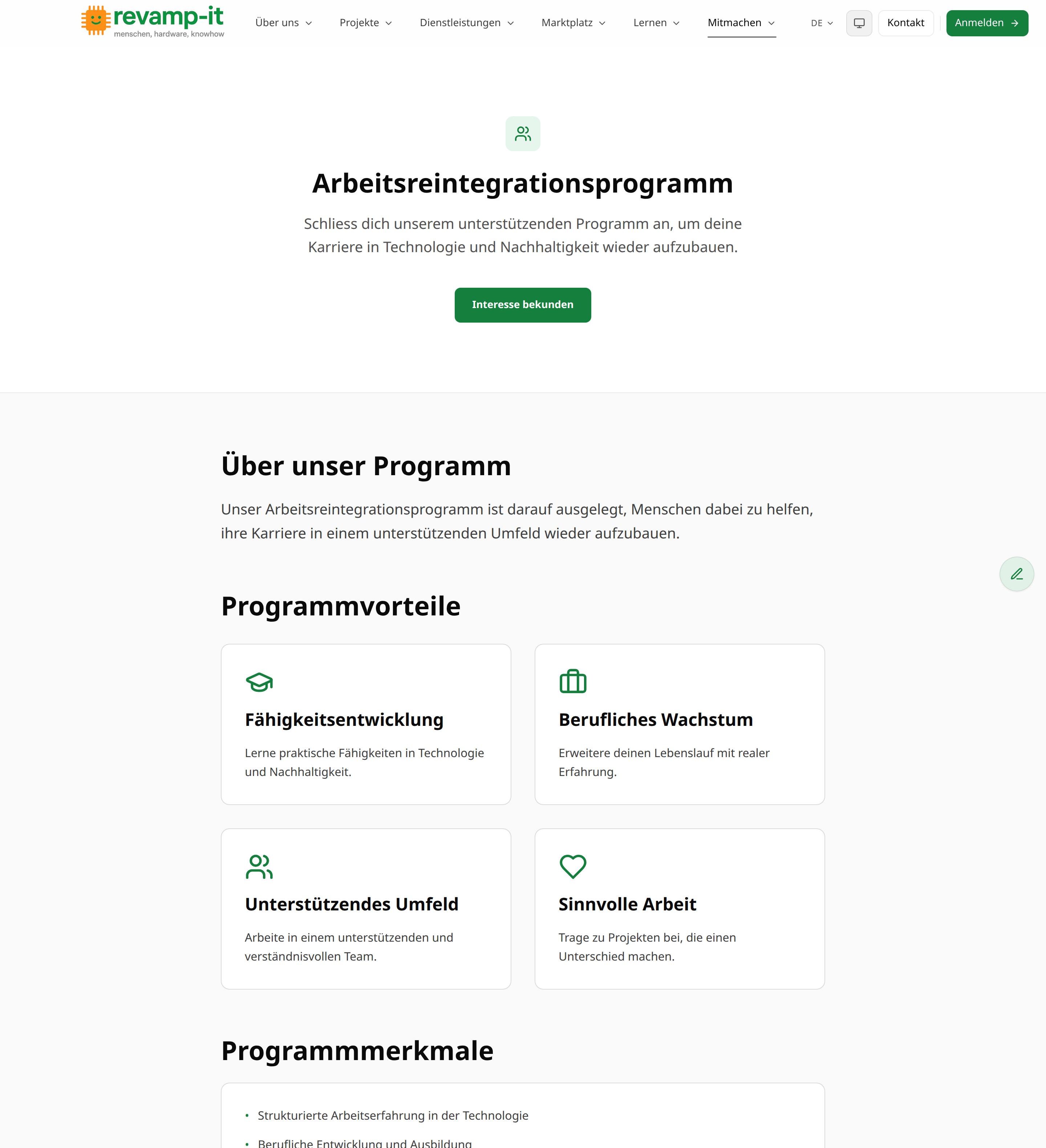 The work reintegration programme: skill development, professional growth, a supportive environment and meaningful work — the four promises against which the programme can be measured.
Measuring without measuring people up
An organisation that is serious needs processes and must measure its impact. We want to know whether our approach carries: do people move forward? Do they find their way back into work? That is not bureaucracy, that is responsibility — towards the people who trust us, and towards those who make our work possible. We apply the same stance to our ecological impact: every figure is disclosed and derived, nothing is merely claimed.
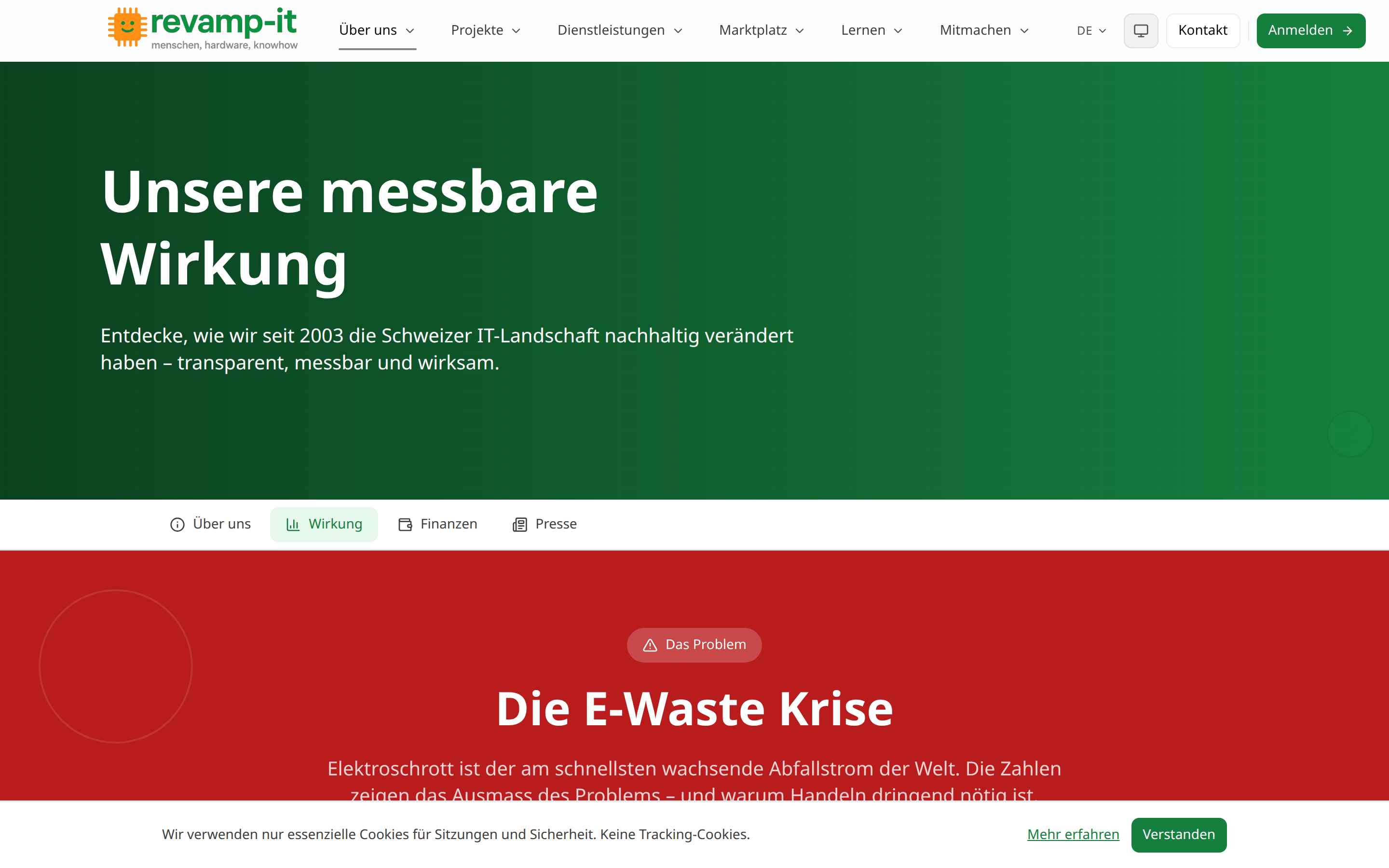 Transparency as a principle: on the impact page we disclose figures and derivation — for the environment as for the people.
But here lies the fine line that matters. A person returning to work must never feel measured up. Anyone who has the feeling of being watched and judged makes themselves small — exactly the opposite of what we want. Numbers that decide about a person crush; numbers that show a person how far they have already come lift them up.
That is why the stance matters more than the tool. The portal should make progress visible for the person, not report about the person. The "Development" view belongs to the person themselves. Confidentiality is not an add-on feature but a precondition. And every metric we build must pass the question: does it strengthen this person's self-confidence — or does it only serve our reporting needs? Empathy and impact measurement are not mutually exclusive. But the order is not negotiable: first the person, then the metric.
Publicly co-funded — therefore accountable
Revamp-IT does not sustain itself solely from what the workshop and marketplace earn. Part of our work is co-supported by the KlimUp funding programme of the City of Zurich — Zurich taxpayers' money that the city deploys specifically for climate protection and intelligent resource use. This money flows nominally for the ecological side of our mission — every laptop saved is electronic waste avoided. But public funds are fundamentally binding: anyone who works with taxpayers' money owes the public transparency about what comes of it — and indeed about the whole mission, not just the part the money is meant for.
That is why we resolve to measure our impact seriously — the ecological as well as the social — and to disclose it. Not because a regulation demands it, but because it is the honest handling of trust. The ecological side we already disclose today on our metrics page, every figure with its derivation. The social side — reintegration — is harder to measure without measuring the people up. But harder does not mean impossible. It just means: more carefully.
Two levels that must never be confused. The personal level belongs to the person and no one else. Here it is about growth that becomes visible for them — the growing skills list, milestones reached, a voluntary self-assessment of how confident they feel. These numbers do not leave the "Development" view; they are a mirror, not a file. The programme level, by contrast, is aggregated and anonymised. Here we do not ask "How is person X doing?" but "Does our approach carry?" — from many individual paths becomes a metric in which no single person is recognisable anymore. Precisely these figures may and should go outward: to the funders, to the public, to ourselves. The rule behind it is simple: individual data lift the person up, aggregated data steer the programme. As soon as an individual number decides about a person or compares them with others, we have crossed the line.
What we could concretely measure. The following selection orients itself on what the research knows to be meaningful — the transition into work (the IPS result), self-efficacy (Bandura), retention over time — and on what we can collect without building a surveillance apparatus:
| Metric (programme level, aggregated) | What it shows | Where the data come from |
|---|---|---|
| People in reintegration per year | the programme's reach | the HR track in the portal |
| Transition rate into a follow-on solution | whether reintegration succeeds (regular job, training, follow-on programme) | closing capture at programme end |
| Retention after 6 and 12 months | whether the transition holds, not just succeeds | voluntary follow-up survey |
| Self-efficacy before / after | whether confidence grows — the actual core | short, voluntary, validated self-assessment |
| documented skills per person (average) | whether and how fast ability grows | the profiles — arises as a by-product |
Deliberately not on this list: individual "productivity," rankings, pace comparisons between people. Such numbers may fill a report, but they damage exactly what we want to build.
Where the portal makes the difference. The most important point is at once a technical and an ethical one: almost all these metrics are a by-product of the work that happens in the portal anyway — no additional data-capture effort, no separate surveillance apparatus. When someone catalogues a device, posts a listing or ticks off a task, the proof of "real work" arises by itself. When the skills list in the profile grows, the growth curve arises by itself. The portal only has to count these trails anonymised together — each person counts once, without a name — and from it comes a programme dashboard that can stand next to our ecological metrics page. Because the data come from a single source — from what is already captured anyway — there is no double bookkeeping, no contradictory numbers and no reason to burden people with forms. Only two things have to be consciously added, and both belong first to the person: the voluntary self-assessment of self-efficacy and the follow-up survey on retention. Both are optional, both are anonymous at the programme level, and both give the person something back before it is reported to anyone.
Thus the circle closes back to the stance from before: the portal measures by making visible what the people accomplish anyway — and translates it into accountability only when no single person is recognisable anymore. Making the impact bigger and protecting the people is no contradiction, as long as the measurement arises out of the work itself instead of alongside it.
A more individual approach — what we could build
As much as today's building blocks work: they are team tools that are also used for reintegration. The next step would be to make the individual development path its own, first-class citizen in the portal. Honestly: that is not built yet today. But it is close, and it would make the work of social support noticeably easier and more effective.
| Built today | What we could build |
|---|---|
| Skills as a keyword list | Skills with proficiency levels and a history showing growth over time |
| Goals as a free-text field | A development plan with milestones that one reaches and ticks off individually |
| Interests as a list | Interests and wishes that suggest matching tasks and learning steps |
| Ticking off tasks | Tasks that belong to a learning path — from the simple to the demanding |
| Profile as an internal view | An exportable portfolio for applications, with proven skills |
| Assigning a buddy manually | A calm support view in which a person's progress, mood and next steps come together |
The last row is the most important. A supporting specialist today juggles much in their head and in scattered notes: where does this person stand? What was the last good step? What is the next? A confidential, protected place in the portal, where a person's path comes together clearly — skills, milestones reached, open tasks, agreed goals — would relieve this work of the bookkeeping and free the view for what matters: the person.
The "learning path" in the middle row, by the way, also has backing in the research. Experiences of success strengthen self-confidence most when the tasks are just right in difficulty — doable, but not handed over. A path that leads from the simple to the demanding keeps people exactly in that zone where "I did it" becomes real confidence.
Such an individual approach would above all take seriously what people bring with them: their interests, their inclinations, their dreams. Not everyone who starts over with us wants to become a repair technician. Some discover cataloguing and describing, some customer contact, some logistics, some teaching in a workshop. A portal that records this direction and suggests matching next steps can ignite a passion — and turn "some occupation" into a path that belongs to the person. Paths that belong to you, you keep walking.
Why this belongs to the mission
It is the same basic idea that saves a working laptop from ending up in electronic waste: it is a waste to write off something valuable just because the market happens not to be looking. And the waste with devices is on an enormous scale: according to the UN's Global E-waste Monitor 2024, 2022 saw 62 million tonnes of electronic waste worldwide — growing five times faster than the documented recycling, of which only 22.3 % is captured. Much of it is not broken, but merely old, slow or unfashionable.
Switzerland collects exemplarily: in 2024 the take-back systems Swico and SENS processed around 135,200 tonnes of old devices, with a mandated recovery quota of at least 75 % (Fachbericht 2025 by Swico Recycling and SENS eRecycling). Yet recycling is only the second-best solution. A life-cycle assessment by Empa shows why: for computers, laptops and smartphones, the largest part of the environmental burden lies not in operation but in manufacturing — which is why ecologically it clearly does the most good to keep using such a device rather than melt it down and build a new one (Böni & Hischier, Weiter- und Wiederverwendung von elektrischen und elektronischen Geräten, Empa, 2018). That is exactly where we come in: reusing beats recycling — with every single device.
For devices we built a workshop. For people we are building a place where contribution counts, becomes visible and grows — and a portal that carries this path. The parallel is not a rhetorical trick: in both cases it is about making hidden value usable again instead of writing it off.
The goal is not only reintegration into the labour market. The goal is that a person finds something they enjoy learning and enjoy doing — and thereby becomes a sustainable, load-bearing part of their community. That is exactly where the circle closes back to menschen, hardware, knowhow: we don't just repair devices, we help people rebuild their know-how and their self-confidence.
Part of this is already in place: profiles, teams, tasks, votes, a dedicated track for reintegration. The next part — the individual development path as a first-class citizen, thought through empathetically and kept confidential — is the work that lies ahead of us. Anyone who would like to walk this path with us or make it possible finds the entry point under Get involved. It is worth it, because it starts exactly where the mission becomes most human.