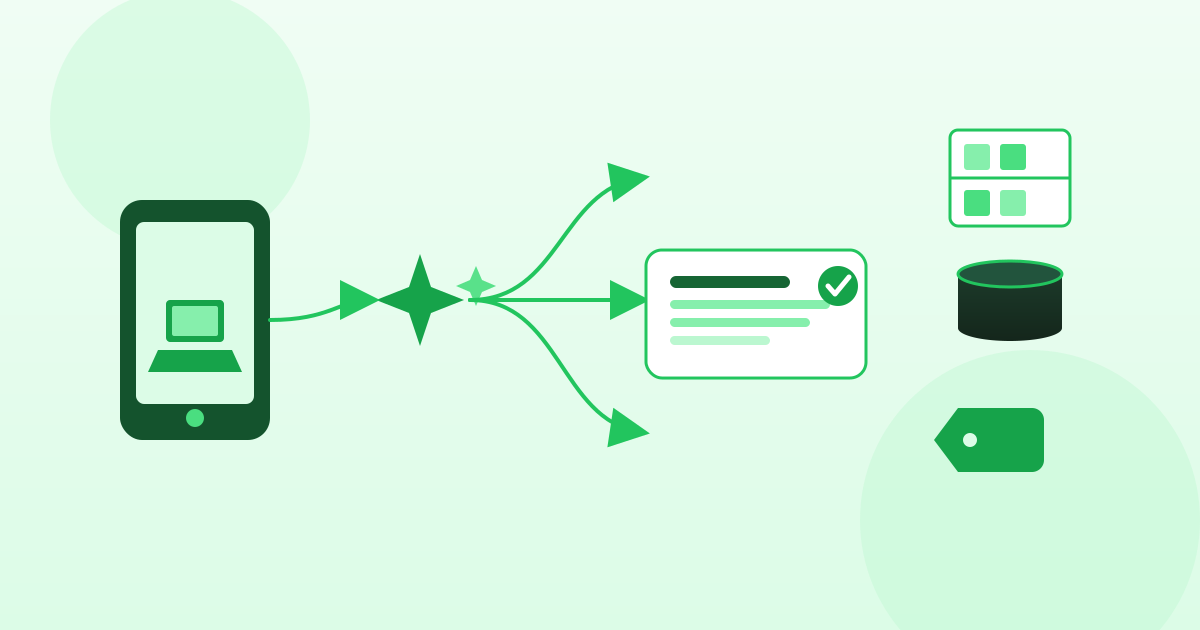
Every device that gets a second life at Revamp-IT first has to get into the system. Sounds trivial. It wasn't. This unremarkable step — intake — is where the workshop lost the most time for years, and it's where there is the least value to add: a laptop doesn't get better because someone types out its specs. This is the story of how we turned fifteen minutes of manual work into an intake that takes seconds — and what's underneath it, technically.
The problem: intake was a chore
In the beginning there was a spreadsheet. To record a device, you did the following, in order: weigh it, take its dimensions with a tape measure, snap a photo, then google together the specs and a plausible price — model number, CPU, RAM, sale price, all typed by hand into a private spreadsheet (copy-pasted, mostly).
Then the hand-off chain began. Heinz merged the individual sheets into one master spreadsheet and exported it as CSV. Cem uploaded that CSV into Kivitendo, our Perl-based ERP and compliant book of record. And even then the device was visible nowhere: it did not appear in the shop automatically — that was yet another separate, manual step.
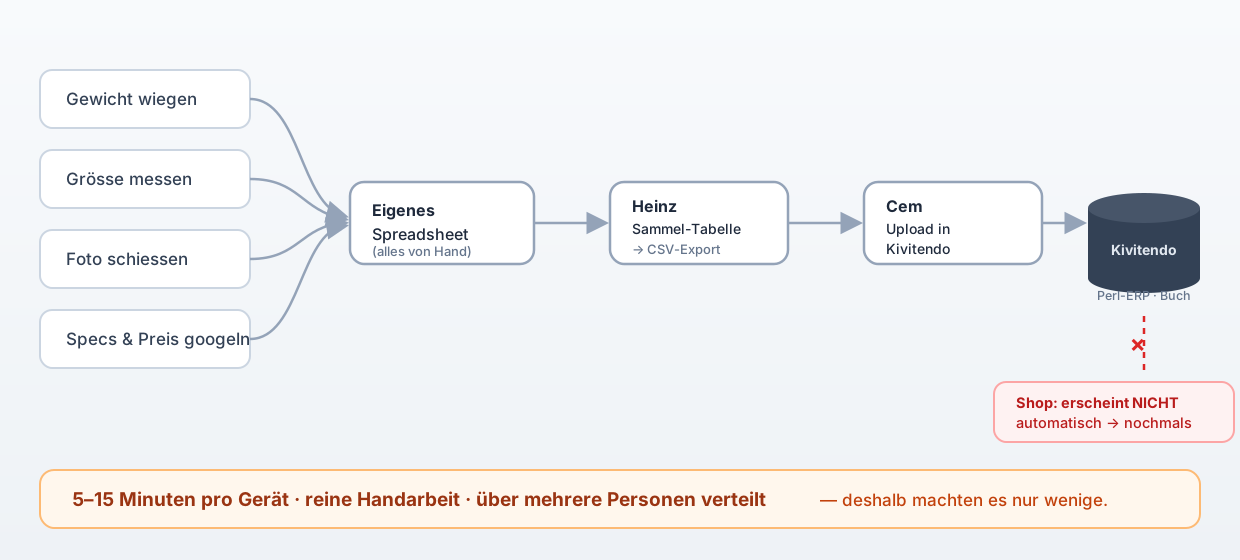
Five to fifteen minutes of pure manual work — per device, spread across several people. The outcome was predictable: everyone on the team was supposed to do intake, but only a few did. Not out of ill will, but because the barrier was too high. A process nobody enjoys becomes the bottleneck — and a pile of unrecorded devices grows in the warehouse.
The vision: drive intake practically to zero
The goal was deliberately radical: cut the time it takes to get a product into the system by 99.9 %. Not "a bit faster" — a different order of magnitude.
The reasoning: a photo of a device already contains almost everything we need to know — make, model, often even condition. A written name ("Lenovo ThinkPad T450 i5") likewise. With AI that turns this raw material into structured fields, and with carefully built systems that talk to each other over APIs, one gesture should be enough: photograph or type — and the device lands where it belongs. Linked to a storage location in the database, or published directly as a listing in the shop.
How it works today
One intake, four channels
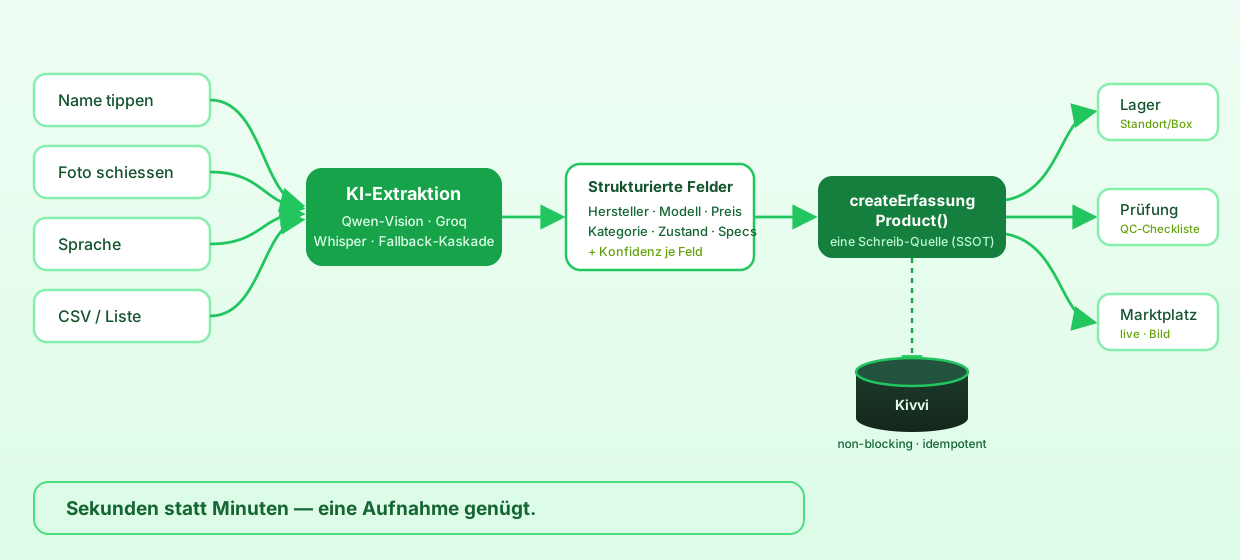
The Geräte-Eingang (device intake, erfassung in the code) has a deliberately plain interface with four input channels: text, photo, file (CSV/Excel) and voice. The design decision behind it matters — these are channels, not four separate workflows. However the data comes in, it converges on the same product record.
The text channel is clever: it detects automatically whether a line is a single device or a whole list. One line goes to /api/admin/erfassung/text, several lines to /api/admin/erfassung/bulk-text — so you can paste a whole pallet of devices at once and get a bulk review table back. CSV and Excel files run through bulk-upload, voice through voice.
The AI cascade
The heart sits in src/lib/erfassung/ai-extraction.ts. extractProductFromText sends the text through a fallback cascade of three providers (callWithFallback): Groq first (llama-3.3-70b-versatile), then OpenRouter, then a local Ollama. If everything fails, a regex parser (fastParseProductText) is the last net — intake never hard-fails, it just gets less precise.
For photos, extractProductFromImage takes over. A small story from the engine room is worth telling here: Groq retired its previous vision model (Llama 4 Scout) — requests suddenly came back as 404 model_not_found, and photo analysis was dead in production. The replacement today is qwen/qwen3.6-27b, the only currently available image-capable Groq model. But Qwen3 is a reasoning model: it thinks out loud in a <think>…</think> block before answering. A naive "grab the first {…}" parser promptly fished example JSON out of that thinking block and failed. The fix is a small, unspectacular function, extractJsonObject, that strips the reasoning blocks and the json code fences before the JSON is read. Voice, in turn, is transcribed with Groq's whisper-large-v3-turbo and then goes through the same text extraction.
Two things make the result usable rather than merely impressive. First, per-field confidence: every extracted field carries a certainty; the review form highlights only the fields that genuinely need a second look (a condition the text never stated, say), instead of plastering every value with a percentage. Second, categorization: detectCategory is an ordered pattern table mapping onto the existing category codes. The order is intentional — accessory, printer, monitor and network patterns match before the laptop brands, and internal components last, so a device name always wins. That way "Dockingstation Lenovo ThinkPad" is correctly filed as Network and not as a laptop.
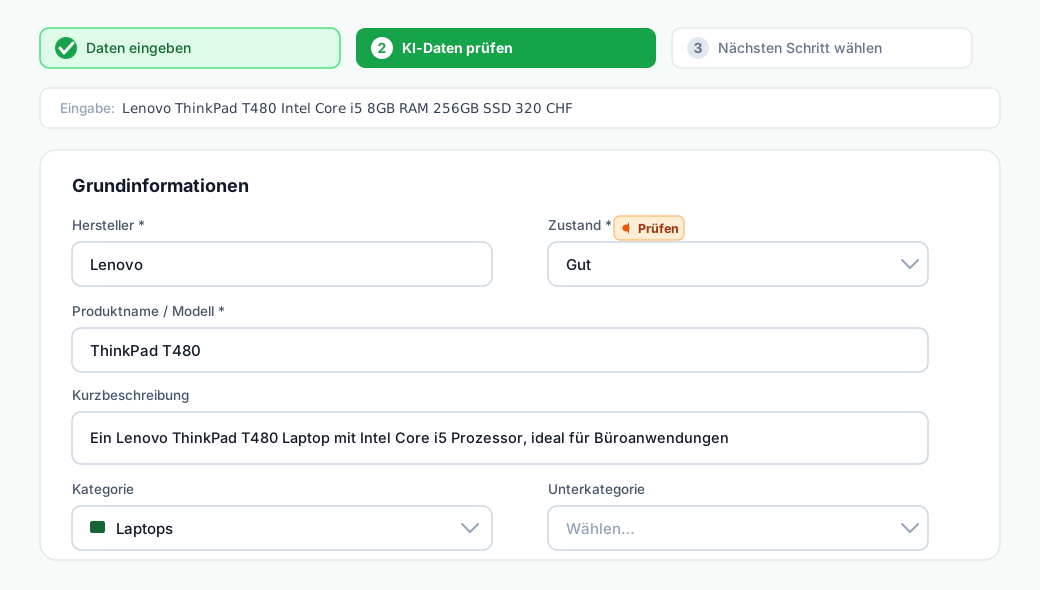
In the interface this looks like this: you type a sentence, and seconds later a filled form appears — make, model, a written-out short description, the category. Exactly one field here carries a small orange "Prüfen" (check) hint: the condition, because the text never named one. Everything else is quiet. That's the crux — the AI doesn't shout "95 % sure" into every line, it quietly points at the one thing a human should confirm.
A single source of truth for writes
However different the channels are, writing happens in exactly one place: createErfassungProduct() in src/lib/erfassung/create-product.ts. This function is the single source of truth for "a device comes into being." In one transaction it assigns a human-readable item number (I-YYMMDD-NNNN), writes the extraction record (ai_extracted_products), creates the inventory entry (inventory_items, with location, box and quantity), links customer profiles, uploads the image to R2 (object storage) and links it — and optionally publishes a listing straight away.
Because everything runs through this one function, the same invariants hold everywhere. That's also why we could later migrate 197 products from the old Shopware shop in one pass (more on that below): the import calls exactly createErfassungProduct, instead of inventing a second, subtly different way to write.
The quality gate
After review comes the only real operational decision: where to next? The CAPTURE_DESTINATIONS — quality, inventory, parts, recycling or "shop untested" — map onto intake tiers. A device of a check-required category that you want to publish directly is intercepted by a safety gate and lands instead as a draft in the refurbishment pipeline with a QC checklist — unless someone makes an explicitly logged "publish without check" decision. Whether a category requires a check isn't maintained separately but derived from the checklist itself: check-required means it has a required test or security item for that device class.
Onto the marketplace
When a device is published, publishRevampitListing turns it into an active listing (is_revampit flag), carries the R2 image into the listing images, and indexes the entry in Meilisearch for search. The transition from "recorded" to "visible in the shop" is thus an API call, not a second person with a second form.
The stress test: 197 products from the old shop
The best confirmation that the flow holds was the catalogue migration. The old Shopware shop had no usable API — but clean Open Graph metadata per product page. A small scraper walked the /Alles/ listing, pulled name, brand, price, description and image URL, and a one-off migration endpoint created each of the 197 products as a draft — via createErfassungProduct, with the image downloaded server-side and re-hosted to R2. Categories were inferred via detectCategory, duplicates prevented via the stored Shopware number (idempotent, repeatable at will). What would have taken days by hand was a matter of minutes.
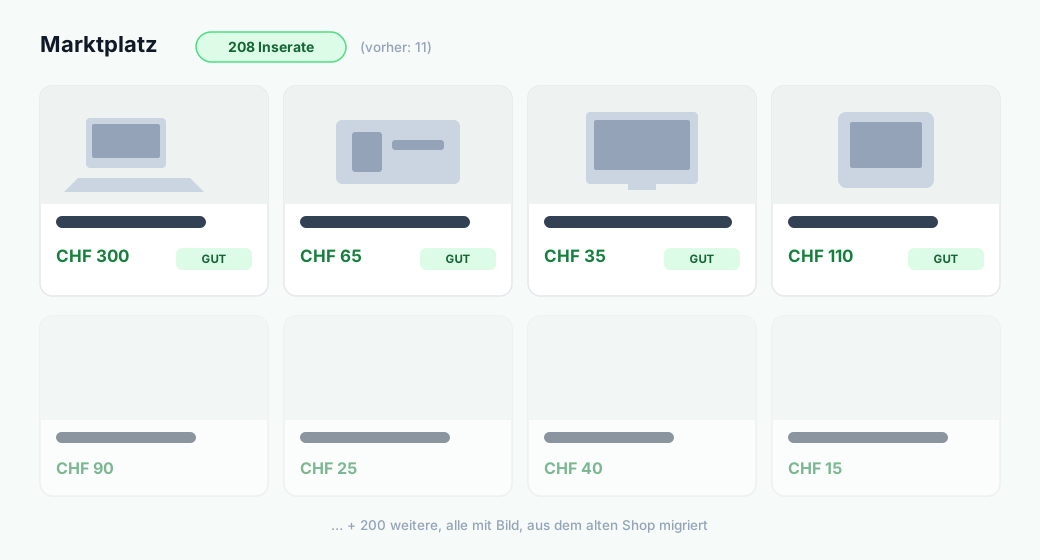
And because the migration ran through the same function as any single intake, the drafts could then be published in a second pass — each becomes an active listing, the R2 image travelling with it automatically. 11 visible listings became 208, each with image, price and category. The old shop wasn't just typed out, it was carried over.
Three principles that carry it
Before we get to the neighbouring systems, it's worth looking at three decisions that make the difference between "works in the demo" and "holds in production" — and that recur throughout the code.
A single source of truth for writes. Whether photo, voice, CSV, single intake or bulk migration: writing happens exclusively through createErfassungProduct. There would have been a thousand temptations to build "a quick second, slightly different path" for the migration. That's exactly what we did not do — and that's why item numbers, image handling, the QC gate and inventory invariants apply the same to every path. A bug is fixed in one place, not five.
Certainty, not percentages. The AI delivers a confidence for every field — but the screen shows no percentages. It shows a "check" hint only where the certainty drops below a threshold. A number like "73 %" is no instruction for the person at the bench; "look here again" is. Good automation reduces decisions, it doesn't multiply them.
Idempotency everywhere it goes out. Every sync to Kivvi carries an idempotency key; every migrated record carries its Shopware number; every publish run skips what already has a listing. This sounds like small stuff, but it's the reason we may repeat migrations, syncs and re-indexing at will, without duplicates or fear. Repeatability isn't a luxury — it's the precondition for being able to repair a system while it's running.
Systems that talk to each other
Intake is only half the job. A device also has to arrive where stock and accounting live. And this is where it gets architecturally interesting, because two very different worlds hang off it.
Kivvi: a clean membrane
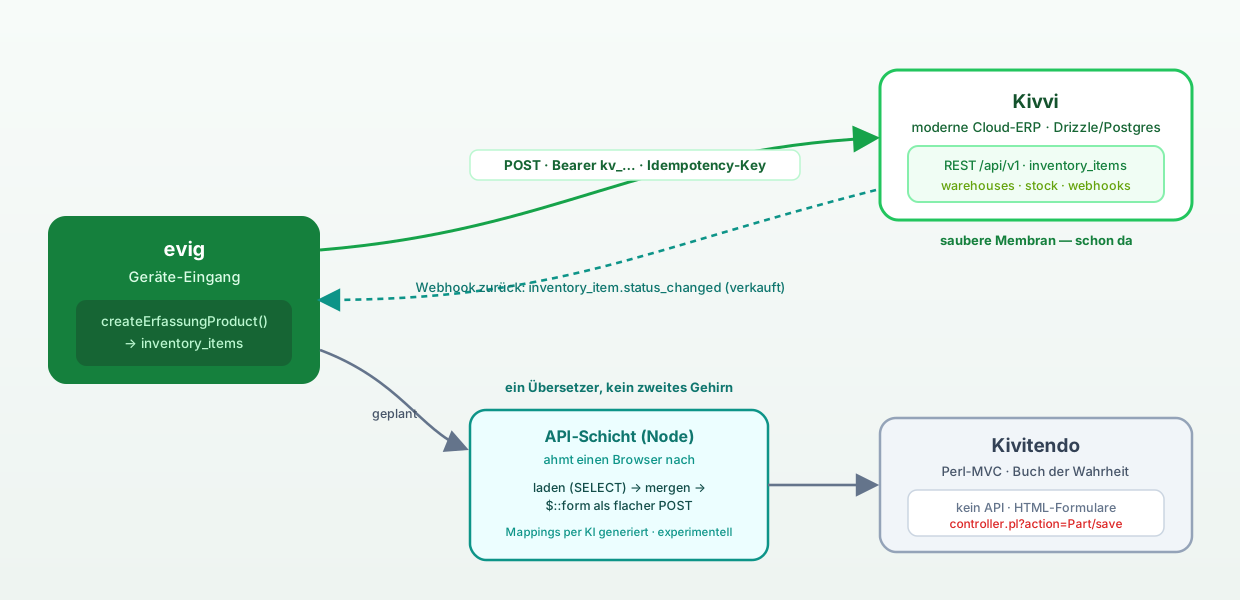
Kivvi is the modern, Swiss cloud ERP (TypeScript, Drizzle/Postgres) we sync devices to. It makes things easy because it offers exactly what an integration partner needs: a versioned REST API under /api/v1/. Our syncToKivvi (src/lib/kivvi/client.ts) does a POST /api/v1/inventory-items with a bearer token (kv_…) held server-side as a SHA-256 hash.
Three properties are decisive here — and in Kivvi's code they're even named for Revamp-IT:
- Idempotency. The call carries an
Idempotency-Key; a double push creates no duplicate. That's precisely why we may retry without worry. - Non-blocking, after commit. The sync is fire-and-forget: it starts after the intake's database transaction and never blocks the recording. Afterwards we write
kivvi_inventory_item_idandkivvi_sync_statusback onto the inventory entry. If Kivvi isn't configured (noKIVVI_API_URL), the client cleanly returns{ success: false }instead of throwing — in dev, simply no sync. - Bidirectional. Kivvi sends signed webhooks back (
inventory_item.status_changed, etc.). When a device is sold there, we learn about it — without polling.
A small but important translation step: RevampIT's condition vocabulary is mapped onto Kivvi's enum (new → like_new, defect → parts_only, unknown → untested). Without this mapping Kivvi's validation rejects the record with HTTP 400. Small contracts, kept clearly.
Kivitendo: a translator, not a second brain
The other neighbour is Kivitendo — a Perl MVC ERP, our legally compliant book of record, which we deliberately keep. The catch: Kivitendo has no API. Its "interface" is the View — HTML forms for humans — and the controller is coupled to those forms. Every request is a POST of flat form fields to controller.pl?action=Part/save, which Kivitendo reassembles into one global structure, $::form.
A write there follows the pattern load → overlay → save, always on the whole object. That has a treacherous consequence: scalars are preserved when omitted — but collections (prices, suppliers) are delete-and-replace. Send a subset, and you lose the rest. So you cannot "just change one field" without having loaded the complete state first.
How do you connect a modern system to that? Not by rebuilding Kivitendo's logic, but with a thin translation layer — a Node service that imitates a browser. Its single flow: receive → load (SELECT) → map inward → merge → send as a $::form POST → map outward → return. The layer never writes SQL itself; writing happens exclusively through Kivitendo's own controller, so its validation, history and transaction stay in exactly one place. The guiding principle: the business logic lives in Kivitendo — we are a translator, not a second brain.
The elegant part: the per-entity mappings needed (which external field is called what internally, which form keys, which custom variables) are generated by small, local LLMs — extracted from Kivitendo's Perl ORM and controllers, round-trip-checked against a real, captured form POST. A mapping is correct if and only if it reproduces a POST Kivitendo accepted, parameter for parameter. Nothing is guessed. This piece is still experimental (the Part entity stands; it hasn't been hardened against a live instance yet), but the path is clear: a clean, versioned contract on the outside, Kivitendo's unchanged truth on the inside.
The honest caveat: much of this is inferred from a few captures and reading the source, not observed under controlled conditions. The least confirmed thing is, of all things, the most important — how Kivitendo signals success versus failure (a redirect carrying &id=… versus a 200 response with an error body). That belongs verified against a running instance first. Honest architecture names its open assumptions.
The missing piece: storage and logistics
And here comes the part that isn't finished yet — named on purpose, because it's the planned work to round the product off.
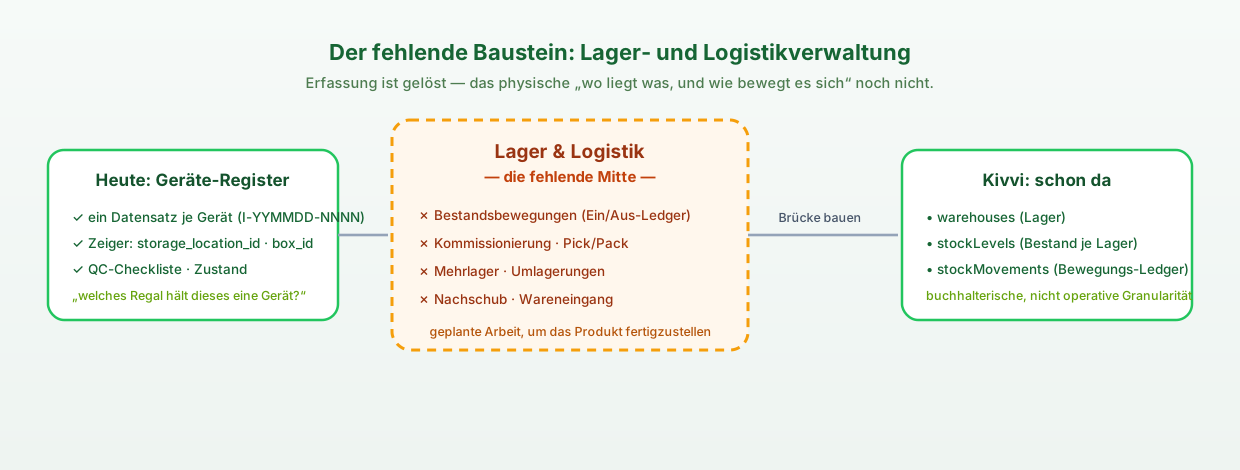
Today the device intake is essentially a single-unit register with a QC checklist and a "where is it" pointer. There's a lean table storage_locations (name, kind: main storage / shop / secondary storage / member possession / …), and the inventory entry carries a storage_location_id, a free box_id and a legacy location field. That answers: "which shelf holds this one device?"
What's missing is everything beyond that — and that, honestly, is the actual storage management:
- No stock-movement ledger. The counters
quantity_reserved/quantity_soldexist as columns but are written nowhere. There are no in/out postings, no movement history. - No multi-warehouse, no transfers. A flat location list, no hierarchy, no per-warehouse stock.
- No picking, no goods receipt, no replenishment. In short: no warehouse management, just a "where is what."
The good news: the docking point already exists. Kivvi brings exactly the stock primitives we lack — warehouses, stockLevels (stock per product and warehouse) and an append-only stockMovements ledger with signed quantities. Though at accounting, not operational, granularity: Kivvi knows warehouses as a name and address, but no bins, no pick routes, no carrier. A future RevampIT storage module therefore has two clean options — either drive Kivvi's warehouseId + location directly, or model the operational layer (bins, movements, picking) itself and run Kivvi as the stock book of record behind it. Thanks to the bidirectional webhooks, both sides stay in sync.
And Kivitendo? In principle the warehouse could be mirrored there too — via the same translation layer sketched above. Kivitendo has a warehouse/stock concept in its model; a stock movement would then be one more entity taking the same path: load, merge, send as a $::form POST to the appropriate controller. The larger effort lies not in the concept but in the care — stock is accounting-relevant, and Kivitendo's "collections get replaced" semantics demand that you always send the complete state. For a book of record, exactly that caution is warranted.
Outlook
Intake is solved: from a photo or a written name, a clean, categorized, illustrated record appears in seconds — located in storage or published in the shop, and synced to Kivvi. The barrier that meant hardly anyone did intake is gone.
What remains is its physical counterpart: knowing where every device is, and booking every movement cleanly. That's the next piece — the bridge between our single-unit register and Kivvi's stock ledger, and, where needed, all the way into Kivitendo. Once it stands, the circle closes: from the gesture that records a device to the shelf it's sold from — without anyone having to keep a spreadsheet in between.